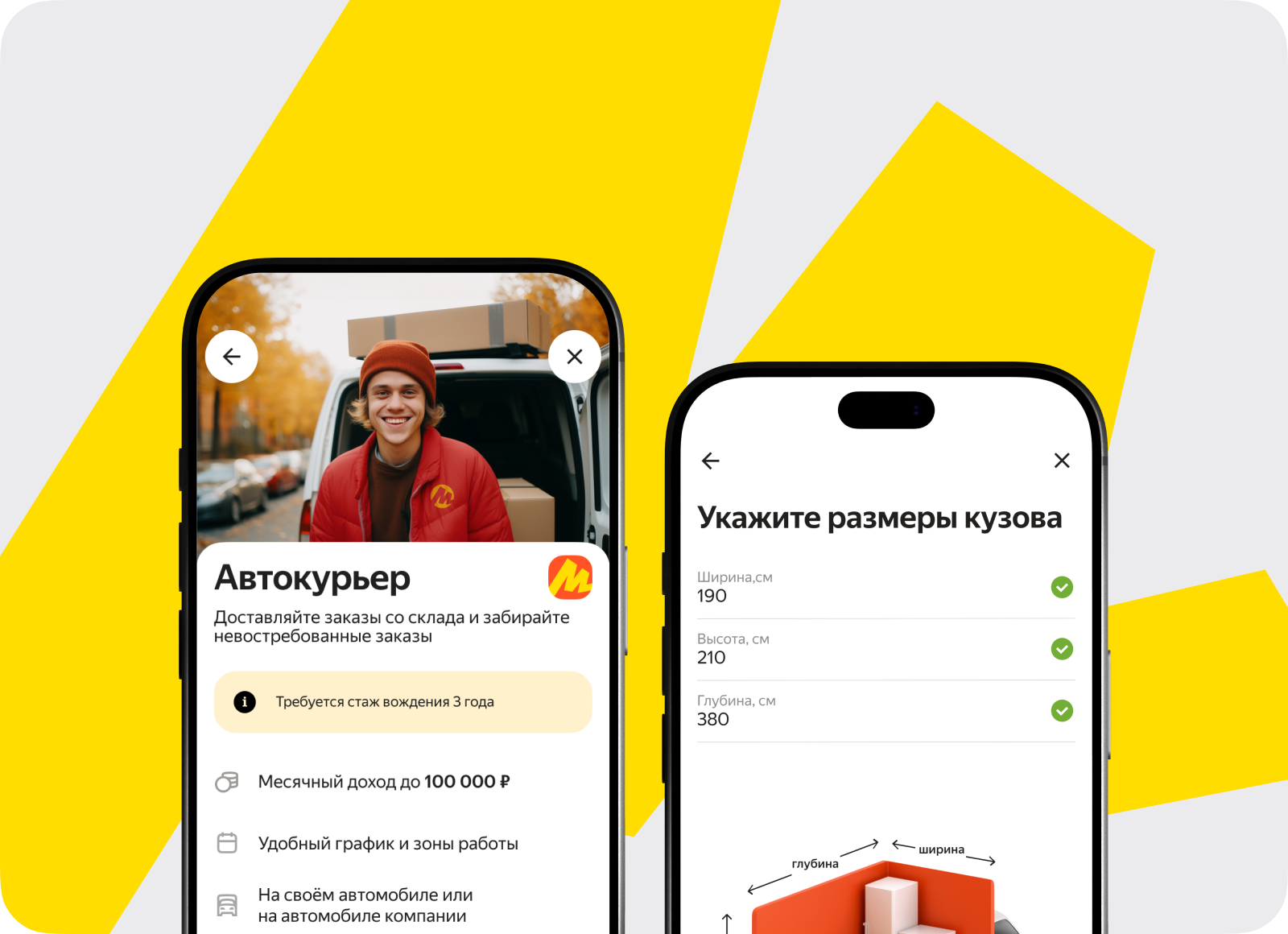

Self-registration workflow for couriers using their own vehicles
Yandex.Market • B2C • 2025 • Mobile
✦
LogPro is an app for finding logistics jobs at Yandex, including courier, warehouse and order pickup point roles. Candidates could apply in two ways: through the landing page or the app. The app already had a large user base, but the existing application flow provided little information about the role and collected only basic candidate details.
Worked as a product designer alongside the product manager and developers. I designed the self-registration workflow for couriers using their own vehicles. The product manager outlined the problem and business tasks, while I worked on the solution.
My Role
We hypothesized that one of the reasons was the lack of information about the job during registration. If we explain the job conditions and gather the necessary information before submitting the application, candidates will be able to choose the vacancy more consciously, and the team can assess their suitability earlier and identify a partner.
Hypothesis
To verify the solution, we need to track:
• the share of candidates who completed the entire registration flow. Our target is a completion rate above 20%;
• the share of relevant candidates among those who completed the entire flow. It should be 22% or higher — no less than the share of candidates who came from the landing page.
• the share of candidates who completed the entire registration flow. Our target is a completion rate above 20%;
• the share of relevant candidates among those who completed the entire flow. It should be 22% or higher — no less than the share of candidates who came from the landing page.
Metrics
According to the initial data, fewer than 1% of users who applied through the app met the requirements and became couriers. At the same time, the data about the candidate from the application was insufficient to determine if the candidate was suitable, necessitating additional phone calls.
Problem

I moved from the general to the specific. First, I mapped out the steps, then created rough wireframes. This allowed me to discuss the solution with the developers and identify technical constraints before diving into the detailed interface design. At this stage, it became clear that I needed to reuse a document photo capture flow from another app. I clarified which specific screens could not be altered and integrated these pre-existing screens into the new registration workflow. Once the structure was approved, I designed the screens, including loading and error states.
Working in iterations

I used the ready-made components of Yandex’s mobile design system. I focused on adapting the interface copy to explain the role, requirements and actions at each step.
Using the design system
Explaining the requirements. I added information about couriers’ responsibilities: delivering orders to customers and pickup points, and returning uncollected items to the warehouse. The flow also explained the requirements for vehicles, driving licence categories and driving experience.
Choice of vehicle and type of delivery. Candidates enter their vehicle details and select whether they will use a truck or a passenger car for deliveries. These details help the team assess the application and determine the next steps in the onboarding process.
Data collection and document photo uploads. Candidates enter their details directly in the app. I integrated the existing photo upload flow into the registration process, taking development constraints into account.
Loading and error states. In addition to the main path, I designed how the interface behaves while data is loading and when errors occur.
Solution

